Carlos Rodriguez has run his barbershop in the Pacific Mutual Building for 30 years. (Photo/Your Credit Here)
Every job has its paperwork, but one group of city employees has honed its proliferation to a fine art.
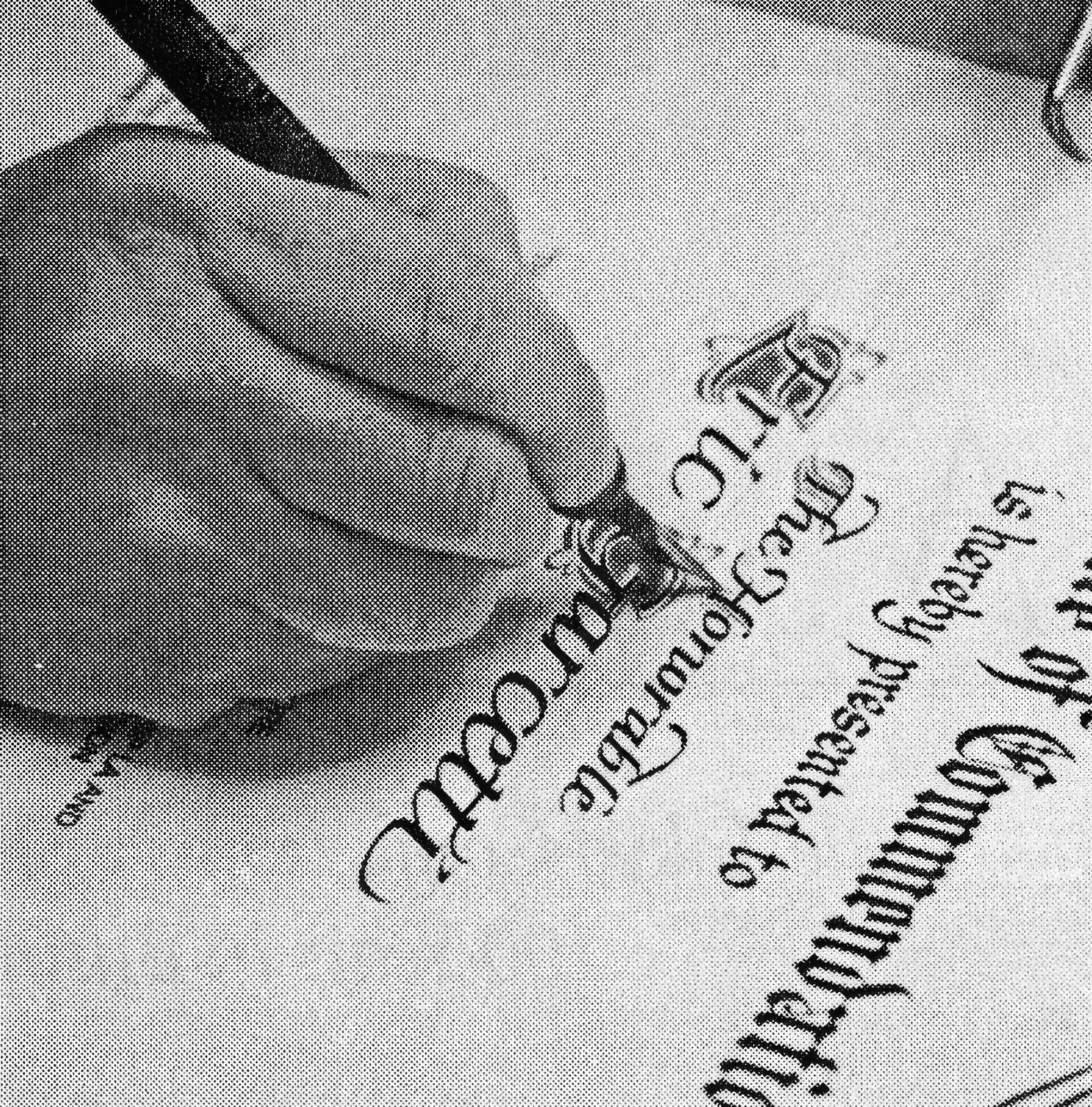
In fact, the work of those in the Creative Services Department graces walls the world over, conveying the City of Los Angeles’ best wishes to prominent citizens, community organizations and visitors in the form of elaborate, hand-lettered proclamations. From their second-floor offices in City Hall, the eight calligraphers who serve under the direction of City Clerk Mike Carey tackle the truly illuminative tasks of municipal government.
But don’t ask them about it.
In the tradition of medieval monks — or perhaps Herman Melville’s character Bartleby the Scrivener — they prefer not to be interviewed or observed, but rather to remain clois-tered, silently toiling away at their craft.
The silence could be because they are so busy. Last year alone, Creative Services produced 24,292 manuscripts, according to Sahar Moridani, a press deputy to Mayor Jim Hahn. He said the number climbs steadily every year.
“Pretty much any document that you can think of that might be appropriate for calligraphy, they’ve been asked to do,” says Moridani. The embellished manuscripts include messages welcoming visiting dignitaries, commendations for members of the pub-lic, birthday greetings or congratulatory honors, civic resolutions and proclamations of special events and holidays. The vast majority of these are drawn up at the request of the may-or, city attorney or council offices.
Stacy Marble, special assistant to Fourth District Councilman Tom LaBonge, helps to coordinate such re-quests. For her, Creative Services holds few mysteries.
“Technically, council people present certificates, since only the mayor’s office can issue a true proclamation,” she ex-plains. “There are around 35 standard certificates that an office can choose from — appreciation, recognition, friendship, welcome, birthday greetings.
There are around 35 standard certificates that an office can choose from
Carlos Rodriguez
“There are also resolutions, which are the big, fancy scroll-like documents,” Marble continued, adding that the latter require a seconding council member and carry the signatures of the council president, currently Alex Padilla, and city clerk.
In addition to the standard, pre-worded favorites, officials can also request certificates bearing special text they pen themselves. For the most part, the schedules of council people drive the certificate process, since many officials use them to commemorate civic groundbreakings, non-profit events, business openings and other district activities.
Given hectic city calendars, rush jobs are common, though Marble says the standard request process normally takes two weeks. “You literally have to walk your order form down [to Creative Services] and stamp it in,” she says.
Suitable for Framing
Most agree that the finished product is well worth the trouble. In the United States, handcrafted proclamations are becoming increasingly rare, and the skill and flair of Los Angeles’ calligraphers rival even their federal counterparts in the nation’s capital, claims Barbara Close, a past president and public relations representative for the 500-member Society for Calligraphy of Southern California.
“They are absolutely gorgeous,” Close says of the city’s manuscripts. “They start off with a pre-printed, foiled city seal, and then the calligrapher will put in the recipient’s name or organization and doctor it up with highly decorative, often cloud-like effects, so it’s outstanding on the document.”
Close says calligraphy requires not only talent, but also a grasp of specialized materials, centuries-old techniques and styles (known as “hands”), and the same level of lifetime dedication demanded by any artistic discipline.
“There are some basic, beginning hands that [serve] as a foundation, and then people stylize from there after a few years of really thorough understanding,” says Close.
In the Western tradition, professional calligraphers typically employ broad-edged, chiseled pens dipped into an opaque water-based medium known as gouache to script Roman and italic lettering. Less prone to bleeding than ink, the medium can be mixed with a variety of colors to create the type of truly eye-catching masterpieces turned out by Creative Services.
While people generally associate calligraphy with parch-ment, Close says that today’s scribes usually prefer true vellum or modern papers with a high “rag” or cotton content for the right resistance to pen nubs.
It's a concentrative art, not something you can just mindlessly go and do.
Carlos Rodriguez
“It takes a good four-plus years to become proficient,” adds Close. “It’s a concentrative art, not something you can just mindlessly go and do.”
True to that spirit, Creative Services is selective about the artists it hires.
“They look for people who have the skill and potential to become a calligrapher,” says Moridani. “That doesn’t mean employees have to be perfect when they start, but they have to show the potential to become very good, to practice on their own time, and do well in training.”
Of course, a disposition toward monastic-like silence doesn’t seem to hurt, either.
 Downtown Haunts