
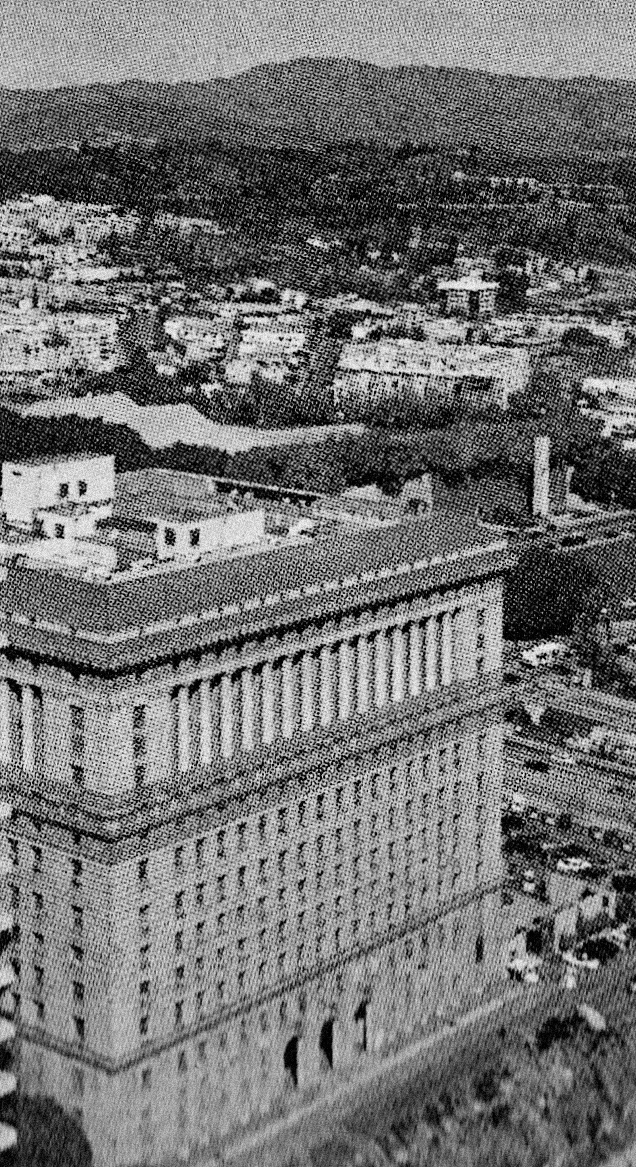
The 1925 Hall of Justice, which is slated for a $127 million renovation has hosted the likes of Marilyn Monroe and Charles Manson. (Photo/Gary Leonard)
If walls could talk, imagine the stories these corridors might tell.
In the 1930s, legendary “trunk murderess” Winnie Ruth Judd found herself escorted through Downtown’sHall of Justice for extradition to Arizona. Even more spectacular was the bomb trial of police lieutenant Earle Kynette, which helped expose the depth of Los Angeles Mayor Frank Shaw’s corruption and send him packing.
Railroaded zoot suiters, Red Scare detainees and real thugs like Bugsy Siegel were forced to stroll these halls in the 1940s, as were neo-Nazi motorcy-clists, Watts rioters, actor Robert Mitchum and many other Hollywood icons throughout the years.
As almost everyone will tell you, in the basement below, Marilyn Monroe finally met Thomas Noguchi, famous “Coroner to the Stars” while notorious killers such as Sirhan Sirhan and Charles Manson protested their innocence on the upper floors.
These are mere slices of the remarkable history of the County building which opened in 1925. Designed by the prominent Allied Architects firm, the 14-floor, Italianate-Beaux Art edifice fronting Broadway, Temple and Spring streets was the nation’s first consolidated judicial facili-ty, originally housing the sheriff, L.A. police chief, district attorney and superior and municipal courts. The sparkling-white, $6 million edifice boasted a 520-cell jail on its top four floors. The Northridge quake brought a hush to the facility in 1994. Served with a red tag, abandoned and chained tight, the once-proud landmark has languished for almost a decade while county officials and preservationists have pondered its chances for reha-bilitation.
“The Hall of Justice is clearly one of the most significant historic structures in the Los Angeles Civic Center,” said Ken Bernstein, director of preservation issues for the L.A.
Conservancy. “It has an imposing stature and solidity that was meant to convey a sense of justice and public importance.”
Bernstein said the Hall also presents “quite a stunning interior,” with an ornate, barrel-vaulted entry foyer that runs the entire length of the structure. Gold-marble walls and large lonic columns support an exquisitely gilded ceiling.
Grime and Punishment
Only a privileged few have been able to glimpse the shuttered hall in recent years.
They describe the interior in less inspiring terms.
“Certain parts of the building have suffered from neglect and look like they’re in bad shape, while other parts of the building just look like they’ve been unused for 10 years,” says John Edmisten, county division chief for capital projects, and one of the officials charged with fixing up the Hall of Justice.
Some offices look like someone just got up and left
“Some offices look like someone just got up and left,” he adds, explaining that after the earthquake, building inspectors allowed occupants little time to evacuate anything but important documents and furnishings. Computers and phones sit lifeless on desks. Papers litter the offices. A few years ago vandals managed to break in and steal piping, causing water damage to some portions of the structure. Grime and cobwebs have tarnished the once-radiant period fix-tures. According to Edmisten, several attempts were made in the late 1990s to find a developer who could renovate the property.
Finally, in 2001 a pre-development deal was struck with Urban Partners to form the Hall of Justice Associates. County officials hoped the shuttered landmark would re-open by 2005, but disputes led to the contract’s termination last July.
“At that point we were faced with whether to drop the project or pursue it on a county-performed basis, and that’s what we’re doing right now,” says Edmisten. He cautions that several hurdles remain, including a favorable environmental impact report, abatement of hazardous materials and demolition of unecessary building components, before any renovation can be done. In addition, each step forward rectification must be approved by a County Board of Supervisors feeling the pinch of California’s budget crisis.
Debt to Society
The current plan calls for a $127 million renovation, to be funded by a mix of county capital, bonds and FEMA grants. Over time, these costs should be recovered as county offices presently leasing space elsewhere return to the building.
“It’s going to be a mixed-tenant administrative office headquarters,” says property development manager Cheryl Fuerth, who is assisting Edmisten with the project. “The sheriff will be headquartered there: Parks and Recreation will be moved and head. quartered there, and then we will have staff from the District Attorney, some from the Chief Administrative Office [and possibly] the Public Defender.”
If it ever happens, it will almost be a full circle for a building that saw a gradual exodus even before the Northridge quake. As their offices grew too large for the 400,000-square-foot Hall of Justice, the L.A. police chief, courts, coroner, district attorney and public defender all sought grander accommodations elsewhere.
Over time, as the other departments left the building, the sheriff took over the space
“Over time, as the other departments left the building, the sheriff took over the space,” says Edmisten, adding that at one point the jail cells became so overcrowded that prisoners were forced to sleep in the halls and on the roof.
By 1991, even the late sheriff Sherman Block wanted out. He moved his offices to the department’s more modern Monterey Park facility.
After the Northridge quake, preservationists worried the Hall of Justice might be consigned to its own death row — until Sheriff Lee Baca announced he wanted to return to the building to be closer to the county seat. Still, like justice, sometimes the wheels of preservation grind slowly. The timetable for a grand reopening has now been pushed to 2007, and that’s only if all goes right. Until then, the Hall of Justice remains a prisoner of time.
 Process of Illumination